
OK, so what's Bitcoin?
It's not an actual coin, it's
"cryptocurrency," a digital form of payment that is produced ("mined")
by lots of people worldwide. It allows peer-to-peer transactions
instantly, worldwide, for free or at very low cost.
Bitcoin was
invented after decades of research into cryptography by software
developer, Satoshi Nakamoto (believed to be a pseudonym), who designed
the algorithm and introduced it in 2009. His true identity remains a
mystery.
This currency is not backed by a tangible commodity (such
as gold or silver); bitcoins are traded online which makes them a
commodity in themselves.
Bitcoin is an open-source product,
accessible by anyone who is a user. All you need is an email address,
Internet access, and money to get started.
Where does it come from?
Bitcoin
is mined on a distributed computer network of users running specialized
software; the network solves certain mathematical proofs, and searches
for a particular data sequence ("block") that produces a particular
pattern when the BTC algorithm is applied to it. A match produces a
bitcoin. It's complex and time- and energy-consuming.
Only 21
million bitcoins are ever to be mined (about 11 million are currently in
circulation). The math problems the network computers solve get
progressively more difficult to keep the mining operations and supply in
check.
This network also validates all the transactions through cryptography.
How does Bitcoin work?
Internet
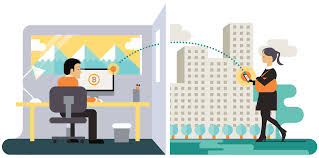
users transfer digital assets (bits) to each other on a network. There
is no online bank; rather, Bitcoin has been described as an
Internet-wide distributed ledger. Users buy Bitcoin with cash or by
selling a product or service for Bitcoin. Bitcoin wallets store and use
this digital currency. Users may sell out of this virtual ledger by
trading their Bitcoin to someone else who wants in. Anyone can do this,
anywhere in the world.
There are smartphone apps for conducting mobile Bitcoin transactions and Bitcoin exchanges are populating the Internet.
How is Bitcoin valued?
Bitcoin
is not held or controlled by a financial institution; it is completely
decentralized. Unlike real-world money it cannot be devalued by
governments or banks.
Instead, Bitcoin's value lies simply in its
acceptance between users as a form of payment and because its supply is
finite. Its global currency values fluctuate according to supply and
demand and market speculation; as more people create wallets and hold
and spend bitcoins, and more businesses accept it, Bitcoin's value will
rise. Banks are now trying to value Bitcoin and some investment websites
predict the price of a bitcoin will be several thousand dollars in
2014.
What are its benefits?
There are benefits to consumers and merchants that want to use this payment option.
1. Fast transactions - Bitcoin is transferred instantly over the Internet.
2.
No fees/low fees -- Unlike credit cards, Bitcoin can be used for free
or very low fees. Without the centralized institution as middle man,
there are no authorizations (and fees) required. This improves profit
margins sales.
3. Eliminates fraud risk -Only the Bitcoin owner
can send payment to the intended recipient, who is the only one who can
receive it. The network knows the transfer has occurred and transactions
are validated; they cannot be challenged or taken back. This is big for
online merchants who are often subject to credit card processors'
assessments of whether or not a transaction is fraudulent, or businesses
that pay the high price of credit card chargebacks.
4. Data is
secure -- As we have seen with recent hacks on national retailers'
payment processing systems, the Internet is not always a secure place
for private data. With Bitcoin, users do not give up private
information.
a. They have two keys - a public key that serves as the bitcoin address and a private key with personal data.
b.
Transactions are "signed" digitally by combining the public and private
keys; a mathematical function is applied and a certificate is generated
proving the user initiated the transaction. Digital signatures are
unique to each transaction and cannot be re-used.
c. The
merchant/recipient never sees your secret information (name, number,
physical address) so it's somewhat anonymous but it is traceable (to the
bitcoin address on the public key).
5. Convenient payment system
-- Merchants can use Bitcoin entirely as a payment system; they do not
have to hold any Bitcoin currency since Bitcoin can be converted to
dollars. Consumers or merchants can trade in and out of Bitcoin and
other currencies at any time.
6. International payments - Bitcoin
is used around the world; e-commerce merchants and service providers can
easily accept international payments, which open up new potential
marketplaces for them.
7. Easy to track -- The network tracks and
permanently logs every transaction in the Bitcoin block chain (the
database). In the case of possible wrongdoing, it is easier for law
enforcement officials to trace these transactions.
8.
Micropayments are possible - Bitcoins can be divided down to one
one-hundred-millionth, so running small payments of a dollar or less
becomes a free or near-free transaction. This could be a real boon for
convenience stores, coffee shops, and subscription-based websites
(videos, publications).
Still a little confused? Here are a few examples of transactions:
Bitcoin in the retail environment
At
checkout, the payer uses a smartphone app to scan a QR code with all
the transaction information needed to transfer the bitcoin to the
retailer. Tapping the "Confirm" button completes the transaction. If the
user doesn't own any Bitcoin, the network converts dollars in his
account into the digital currency.
The retailer can convert that
Bitcoin into dollars if it wants to, there were no or very low
processing fees (instead of 2 to 3 percent), no hackers can steal
personal consumer information, and there is no risk of fraud. Very
slick.
Bitcoins in hospitality
Hotels can accept Bitcoin for
room and dining payments on the premises for guests who wish to pay by
Bitcoin using their mobile wallets, or PC-to-website to pay for a
reservation online. A third-party BTC merchant processor can assist in
handling the transactions which it clears over the Bitcoin network.
These processing clients are installed on tablets at the establishments'
front desk or in the restaurants for users with BTC smartphone apps.
(These payment processors are also available for desktops, in retail POS
systems, and integrated into foodservice POS systems.) No credit cards
or money need to change hands.
These cashless transactions are
fast and the processor can convert bitcoins into currency and make a
daily direct deposit into the establishment's bank account. It was
announced in January 2014 that two Las Vegas hotel-casinos will accept
Bitcoin payments at the front desk, in their restaurants, and in the
gift shop.
It sounds good - so what's the catch?
Business owners should consider issues of participation, security and cost.
•
A relatively small number of ordinary consumers and merchants currently
use or understand Bitcoin. However, adoption is increasing globally and
tools and technologies are being developed to make participation
easier.
• It's the Internet, so hackers are threats to the
exchanges. The Economist reported that a Bitcoin exchange was hacked in
September 2013 and $250,000 in bitcoins was stolen from users' online
vaults. Bitcoins can be stolen like other currency, so vigilant network,
server and database security is paramount.
• Users must carefully
safeguard their bitcoin wallets which contain their private keys.
Secure backups or printouts are crucial.
• Bitcoin is not
regulated or insured by the US government so there is no insurance for
your account if the exchange goes out of business or is robbed by
hackers.
• Bitcoins are relatively expensive. Current rates and selling prices are available on the online exchanges.
The
virtual currency is not yet universal but it is gaining market
awareness and acceptance. A business may decide to try Bitcoin to save
on credit card and bank fees, as a customer convenience, or to see if it
helps or hinders sales and profitability.
Are you thinking about accepting Bitcoin? Do you already use it? Share your thoughts and experiences with us.
To get the best start with Bitcoins go to http://tinyurl.com/m9lm96d and be on your way to earning the income you deserve.
To get the best start with Bitcoins go to http://tinyurl.com/m9lm96d and be on your way to earning the income you deserve.
You can learn all about bitcoin mining, block chains (the database), miner pools, wallets, and transactions at https://bitcoin.org/en/ or http://www.coindesk.com as well as YouTube videos.
Article Source:
http://EzineArticles.com/?expert=E_Speidel

No comments:
Post a Comment